
The most useful way to think about enterprise AI is not by a particular model or vendor. It is by the unit of design.
The unit is no longer the prompt. It is the workflow.
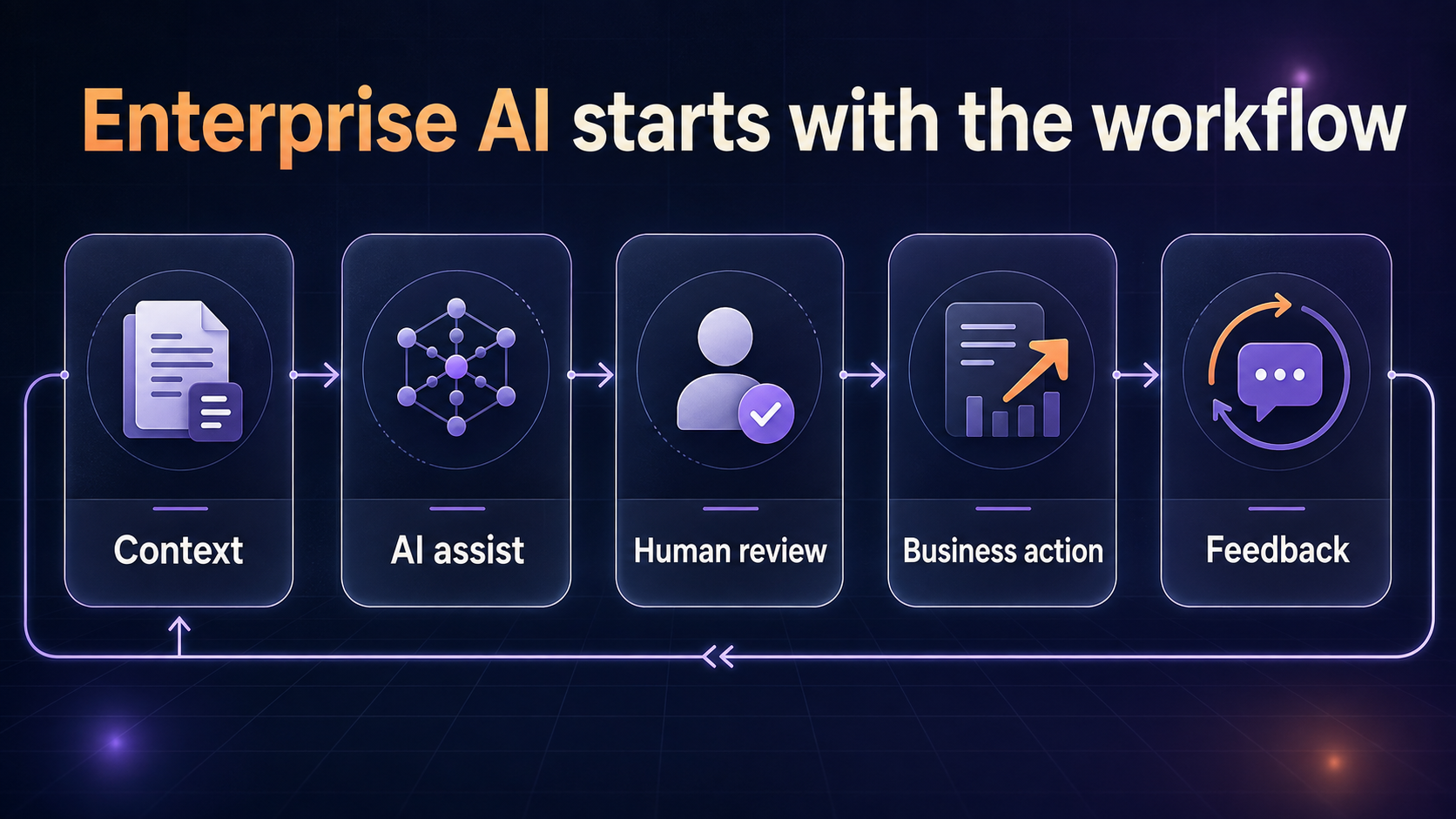
Start with the work, not the model
An enterprise team rarely needs “more AI” in the abstract. It needs a better way to receive a request, gather context, make a first judgment, produce an output, and move the work to the next owner.
That is why the strongest workflows begin with a specific operating problem: recruiting teams cannot respond when candidates are active, finance teams spend days reconciling records, legal teams cannot see where a contract is stuck, or sales teams lose follow-up information across systems.
The model becomes useful because it is placed inside a sequence with a purpose.
Five questions for a real AI workflow
1. What is the painful, repeated job?
Choose work that happens often, has a clear owner, and creates a visible cost when it is slow or inconsistent. A narrow workflow gives a team something it can measure and improve.
2. What does the system need to know?
Define the source records, fields, permissions, reference material, and business rules. If the input is scattered or ambiguous, the output will be difficult to trust no matter how fluent it sounds.
3. Where should AI help?
AI is a strong fit for retrieval, classification, summarization, drafting, comparison, and first-pass recommendations. It is not automatically the right owner for every decision that follows.
4. Where must a person decide?
Make review points explicit. A human may confirm an exception, approve a customer-facing message, validate a financial result, or take responsibility for a high-impact decision. The checkpoint should be part of the design, not an informal rescue step.
5. How will the team learn?
Track cycle time, quality, adoption, rework, exceptions, and business impact. A faster workflow that creates more corrections is not a successful workflow.
What I would carry into an enterprise program
The strongest enterprise examples point to a repeatable delivery pattern: start with one bounded use case, standardize the input, break the work into small steps, add rules and escalation paths, then expand only after the team can see the value.
This approach also makes adoption easier. People can see what the system is doing, where their expertise still matters, and how their feedback improves the next version.
The practical question is not “Can AI do this?” It is “What is the smallest trusted workflow in which AI can help this team do better work?”