
Finance is where the difference between fluent output and trustworthy output becomes obvious.
Finance workflows often include extracting structured fields from invoices, reconciling intercompany records, and creating consistent posting files. The common thread is not a particular tool. It is the decision to repair the data path before adding more automation.
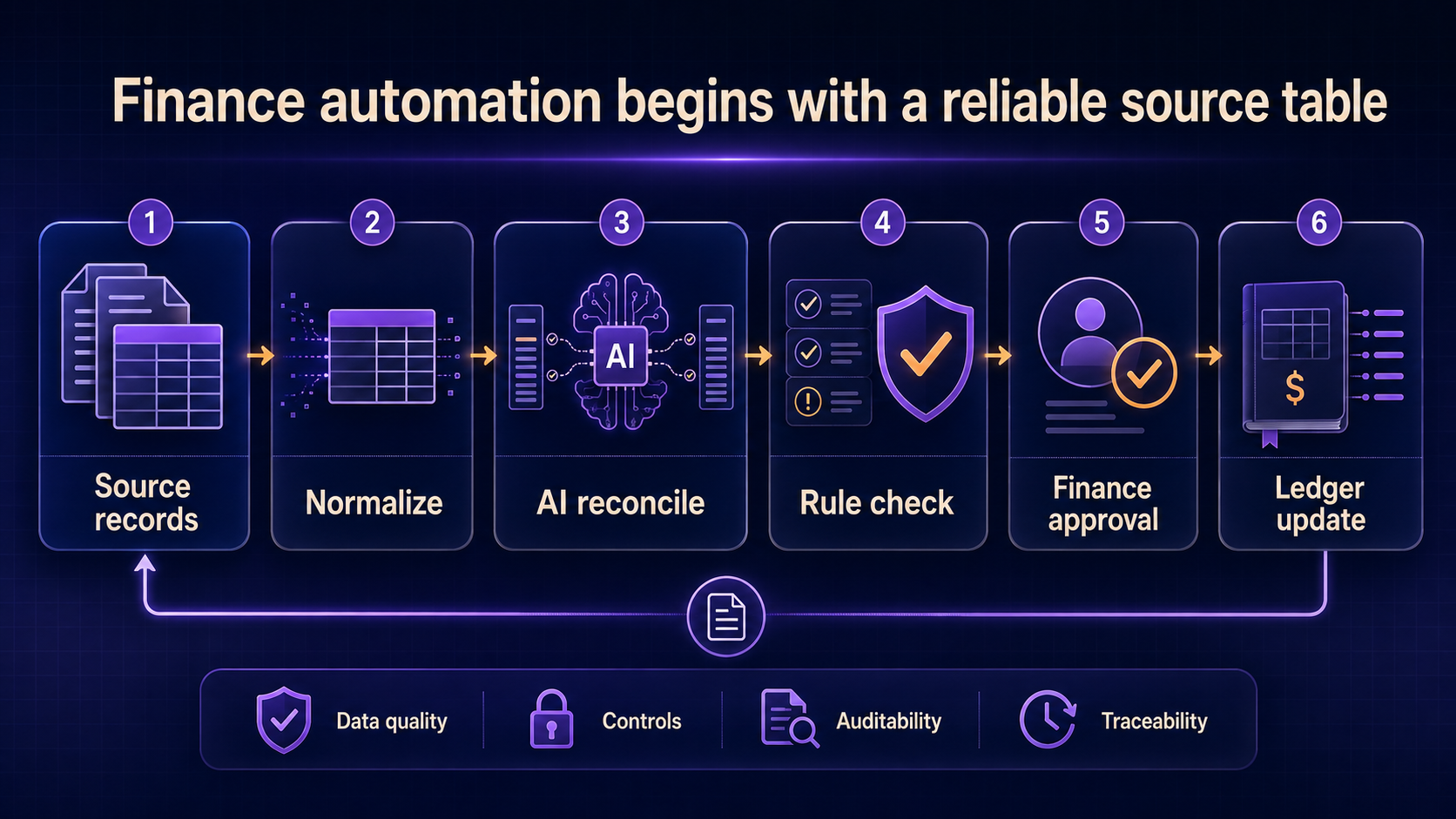
Standardize the source before the action
In one case, the team stopped sending scattered payroll tables to each company and created one standardized source table. The table defined the fields needed for posting: employee, company, department, amount, and payment relationship.
Once the source was stable, the rest of the flow became easier to reason about:
- map the source table into the accounting template;
- use formulas to preserve traceability between the two;
- use generated code for repetitive field completion; and
- use automation to move the prepared files into the right system locations.
AI helped with the transformation, but the real improvement came from making the input contract explicit.
Use AI where the work is flexible; use rules where it is not
Invoice extraction is a useful example. A finance user may need a different set of fields for tax reporting, cost analysis, or internal review. A language model can make the extraction request flexible, but the resulting table still needs a defined structure and a review path.
For reconciliation, a script can compare thousands of records, isolate the exceptions, and identify the people responsible for resolving them. That is a better role for automation than pretending every mismatch can be resolved without context.
Privacy is part of the design
Finance data often includes bank details, vendors, employees, and transaction values. A practical approach is appropriately cautious: mask sensitive fields where possible, understand where data is processed, consider local deployment for higher-risk workloads, and keep a human check before a result becomes an official record.
The controls do not need to be abstract. A useful implementation can define which fields may be sent to a model, which fields must be masked, which outputs require review, and how the source and final result can be compared later.
The business lesson
The right question is not “Can AI post the books?” It is “Which part of the finance workflow can be accelerated while preserving an auditable path from source data to approved result?”
That framing leads to smaller pilots, clearer controls, and a better chance that automation will survive the first exception.