
Industrial inspection is a useful test for enterprise AI because the cost of a false result is tangible. The system must work under real lighting, at production speed, with rare defects, and in a way that experienced operators can understand.
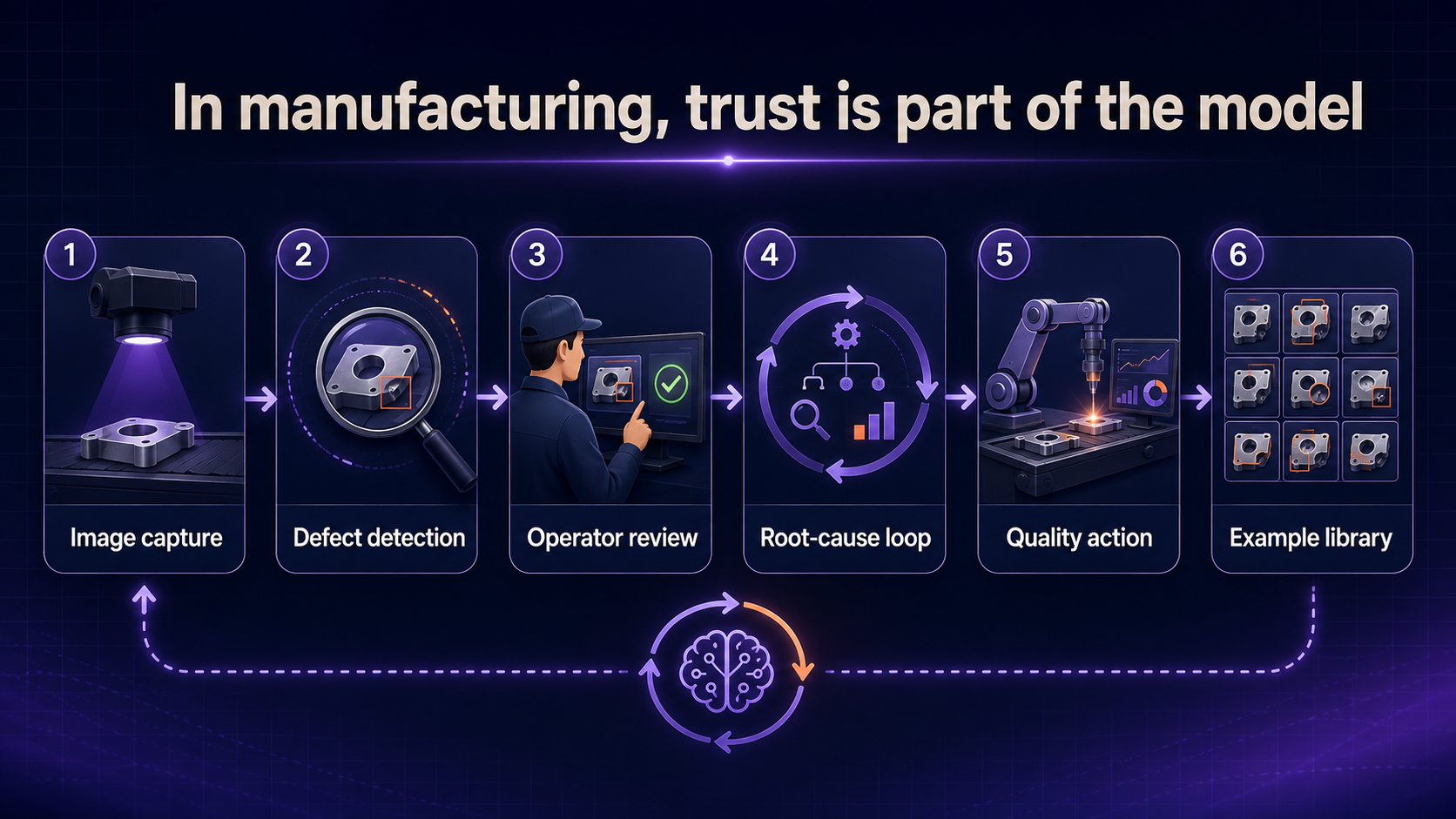
A steel-ball inspection workflow illustrates a practical loop rather than a one-time model deployment.
Make the input consistent
The inspection process uses controlled imaging so the model sees a comparable view of each part. That detail matters. When light, reflections, oil, or camera position change, a model may appear to become unreliable even though the underlying issue is an unstable input.
The first AI requirement is often not a better model. It is a better capture environment.
Create a useful example library
The system needs examples of defects, but rare defects are exactly the ones that are difficult to collect and label. A semi-automated labeling workflow can let the machine suggest areas of interest while an expert confirms the label.
That turns the inspection line into a learning system: production creates new evidence, experts review the difficult cases, and the model improves from the results.
Show why the system made a call
Trust improved when operators could see the region that influenced the result. A heatmap or highlighted area does not make an AI decision automatically correct, but it gives a person something concrete to inspect and challenge.
Explainability is therefore not only an ethics or compliance requirement. It is a practical adoption feature.
Make the expert a coach
One of the most transferable lessons is the role change for experienced inspectors. The goal is not to pretend that decades of judgment are no longer needed. It is to let that judgment become the standard, the feedback, and the training signal that helps the system improve.
This approach also changes the conversation with frontline teams. They are not being asked to disappear. They are being asked to help define what good looks like and to handle the cases where the system needs help.
For other manufacturing workflows, the pattern is clear: stabilize the input, build the example library, expose the evidence, keep the expert in the loop, and measure both throughput and quality.