
Recruiting is a useful enterprise AI case because the work is both repetitive and human.
High-volume roles create thousands of small actions: publish the role, find a candidate, start a conversation, understand the response, confirm interest, schedule an interview, record the outcome, and follow up. The work is easy to describe but difficult to sustain when demand arrives outside normal office hours.
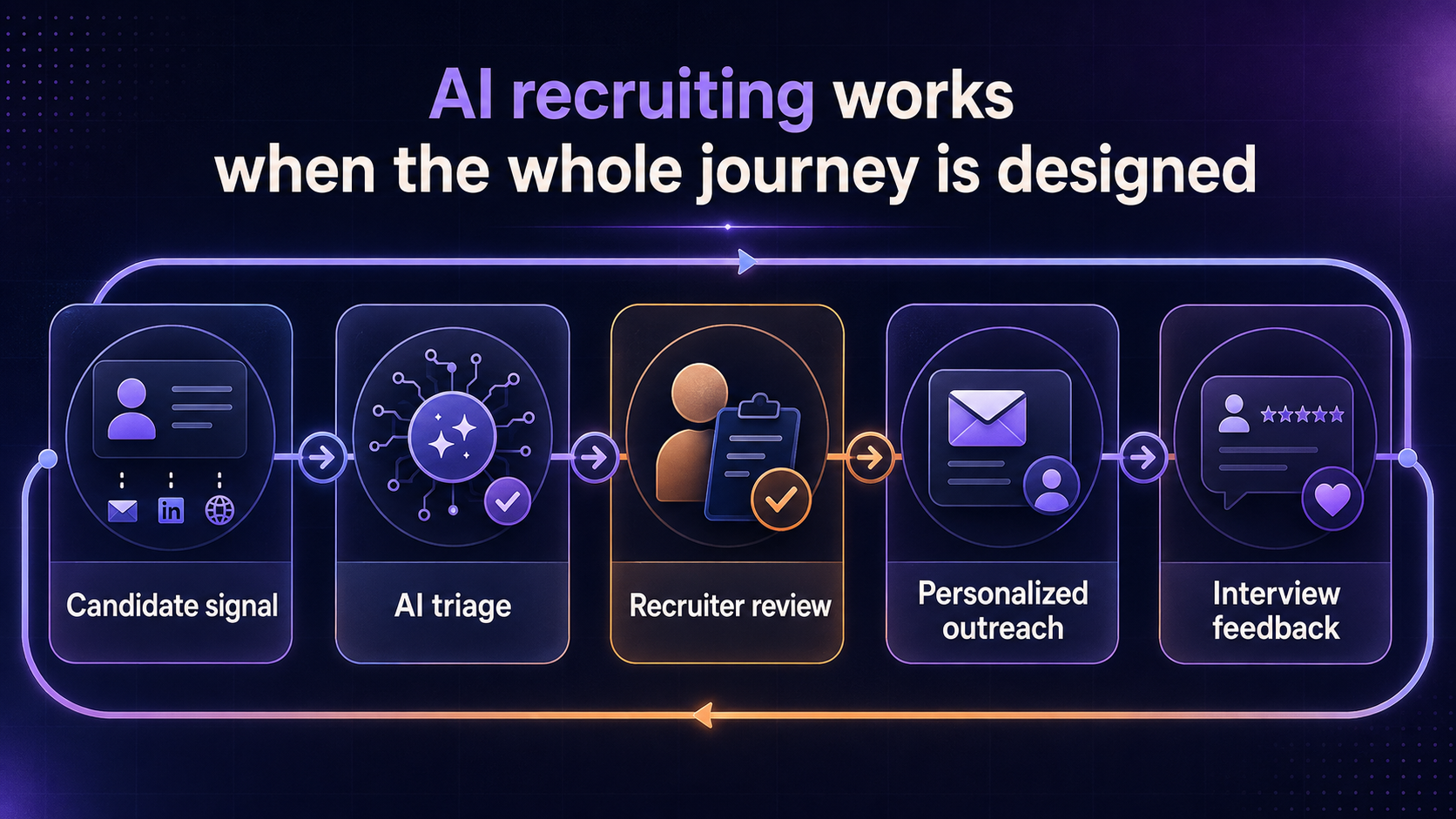
From a point tool to a closed loop
A practical recruiting workflow combines three capabilities:
- a language model to understand candidate responses and adapt the conversation;
- automation to carry out repeatable platform actions; and
- visual interaction to reduce dependence on fragile page-level integrations.
The important design choice is the sequence. The system is configured with the role goal, screening criteria, interview windows, and the definition of a qualified lead. It then handles the repetitive work across the journey instead of only generating a greeting message.
That difference changes the value calculation. A message generator saves seconds. A workflow that moves a candidate from first contact to a confirmed interview can change the capacity of the whole recruiting team.
Keep human judgment in the flow
Full autonomy is not the same as good design. A candidate may be uncertain, a role may have an unusual requirement, or an interview schedule may contain rules that are too complex to leave unchecked.
The case uses human checkpoints for final confirmation and candidate reminders. It also uses deterministic validation for structured rules, such as checking that a proposed interview time fits the customer’s available windows. The model can interpret intent, but code can protect a business rule.
This is a helpful pattern for other enterprise workflows:
- Let AI interpret unstructured input.
- Use deterministic logic to validate hard constraints.
- Escalate uncertain or high-impact cases to a person.
- Write the result back to the system of record.
The operating model changes too
Automation does not only remove tasks. It changes roles. In the case, experienced recruiters can move toward configuring the workflow, improving the decision rules, managing exceptions, and supporting the customer. The work becomes more about designing and supervising the system than repeating every action manually.
The enterprise lesson is straightforward: start with the full journey, define the handoffs, and measure outcomes such as response coverage, interview attendance, quality, and exceptions. AI is most useful when the team can see where it helps and where a person remains accountable.